Wednesday, April 1, 2020

Blooming in March: White Mustard – Chardal Lavan – חרדל לבן – A Cloud of Yellow


March 2020 ניסן תש"פ
My beautiful rose!

The spring flowers are out in full both cultivated and wild. Along my 100 meters I see (and smell) the most perfect rose, nasturtiums, lantana and bird of paradise.  Wild flowers are bursting out of every untended lot and crack in the wall – wood sorrel (chamtzitzim), sow thistle (maror hagina), cyclamens (rakefot – see my blog) and mustard abound.

This month’s blog will be about white mustard, Chardal lavan, because I would like to think that most of my readers might be able to find it 100 meters from their house!  This is because wild mustard grows intensely in habitats that have had human influence – sides of roads, abandoned fields and building sites. Be careful not to pick and eat it from areas that may have been sprayed with weed killer!. 

Wild mustard comes in many varieties but the focus of this blog is the white mustard.  I can hear you all shouting at me – ‘MUSTARD IS YELLOW, AND your photos are all of yellow flowers!!’.  Yes you are right, mustard is yellow and the flowers ARE yellow however this is still called the white mustard!  I would like to say that after much research I found out why White Mustard is called white mustard but I couldn’t.  One place said that it is because the seeds are light in colour as opposed to the seeds of the black mustard, however the seeds that I have gathered are definitely more dark than light.

Mustard is part of the Cruciferous family or in Hebrew matzlivim.  This makes it is easy to identify because the petals of the flower form the shape of a cross.  Even if you get confused with other cruciferous plants then worst case scenario you will end up eating one of six vegetables that were all cultivated from the wild mustard: brussel sprouts, cabbage, broccoli, cauliflower, kohlrabi and kale. (For my mum this is actually the worst case scenario as she hates brussel sprouts with a vengeance).   It grows taller than nearly all the spring perennials (grows back every year), This is the reason that Christian groups that I guide at Neot Kedumim always ask me if they can see the mustard ‘tree’, whose branches birds landed on, as described in the New Testament.  Not only is it tall but it grows in such density that from a distance it looks like a cloud of yellow.

Mustard is the perfect foraging plant (although nothing beats the wild asparagus).  The leaves are edible when young although become very sharp as the plant develops and I recommended chewing them thoroughly as they burn the throat if you swallow them too quickly. They are quite easy to recognize as the leaves are variegated and T shaped.  I like eating the flowers best as they are more subtle and also make such a pretty addition to a salad.  Mustard flowers are not protected and therefore can be picked however it is best to just pick the fully opened flower right at the top and leave the new buds on so that the plant can continue to flourish.  Pop them in your mouth and after a few second you will get a pleasant sharp tang.  You can also eat the new green pods growing out of the side of the stalk, recognizable by their fine white hairs.  Or wait until the summer when the pods dry out and then you can collect the tiny brown seeds.


So what can we use it for?  How about a mustard plaster? Yes you can grind the mustard seeds up into a paste, place on a cloth and place on the chest or swollen and painful joints.  It opens up blood vessels and, draws out toxins, increases blood flow and reduces swelling and pain.  I am a great sufferer of sinus headaches and you can make an inhalation by mixing ground mustard seeds with boiling water and inhaling it from a bowl with a towel over your head.  My head feels clear and pain free after an inhalation.  

Mustard was a big part of my childhood, Friday lunch at home was always frankfurters with mustard and schmaltz (rendered chicken fat!!).  The best takeout was Blooms salt beef sandwiches with mustard.  RIP Blooms, you are sorely missed.  Now I barely eat meat during the week I enjoy a sandwich of veggie shntizel, red pepper and mustard.  

The Old Testament gives no mention of the mustard but The Talmud Babli recommends eating it once every thirty days to prevent sickness in the house, but no more than that as it isn’t so good for the heart!  It was also recommended to be eaten together in the elite houses as an accompaniment to the “gifts for the Priests”.  They are recommended to “eat as the angels eat – roast beef and mustard!”  The Essential Talmud, Rabbi Adin Shteinsaltz.  I always thought that roast beef and mustard was a classic British dish eaten on Sunday lunch but even this dish seemed to have originated in the land of Israel. 

Mustard seed compared to pea!
The tiny seeds in Jewish, Christian and Islamic sources are all a metaphor for something so small having so much significance. This is because the tiny mustard seed grows into the tallest plant and has the most intense flavor.  In our current situation I feel that metaphor can be used to enrich our lives.  At the moment we don’t have the big experiences – shows, restaurants, holidays, parties however we can use this time to appreciate the small experiences. Drinking coffee in the sun, a pleasant exchange with a neighbor or admiring the local flowers.


I think my favorite recipe with mustard is Welsh Rarebit more commonly known as cheese on toast:

·         25g butter
·         1 medium onion, finely chopped
·         1 tbsp flour
·         75 ml Guinness
·         140g mature cheddar, grated
·         1 tsp English mustard
2 eggs beaten

  1. Melt the butter in a saucepan and fry onion for 10/15 mins until soft and translucent.
  2. Add the flour and cook for 1 minute.
  3. Gradually add the Guinness to make a smooth sauce; add the cheese and mustard.
  4. Finally add the eggs on a low heat until the mixture thickens. Do NOT overcook or have the heat too high otherwise your eggs will scramble.
  5. Your mix is now ready to top on your toast (toast both sides of the bread) or mushrooms and grill.
Recipe courtesy of Michele Levy, friend, fantastic cook and fellow blogger. Check out her blog: lovelondonlovefood

Photos courtesy of Yasmin Maissel, a lovely daughter, a lousy cook and a great photographer

Editing courtesy of Elizabeth Kay From HaChamama Shel Elizabeth, friend, neighbour and my adviser on everything!


Thursday, March 19, 2020

Blooming in March: Prickly Asparagus - Asparug Hachoresh - אספרג החורש - A Foraging Challenge in Challenging Times


March 2020 אדר תש"פ


What’s in bloom in Israel this month? A Foraging Challenge in Challenging Times

Prickly Asparagus  

Asparug Hachoresh  
אספרג החורש

What I love most about nature is its seasons, and the knowledge that even when one plant finishes another one will grow and take its place. Even better a new flower pops up and distracts you from the passing of the previous one.  I’m trying to focus on that now during our current crisis.  I’ve been foraging for asparagus the last couple of weeks as the crisis escalates and I feel that the asparagus and Corona are entwined in my mind and even in my taste buds.  However the asparagus season will finish and the Corona crisis will pass and something new and beautiful will grow in its place and we will move forward.  The words of Ecclesiastes 3:1 have never been truer “There is a time for everything and a season for every activity under heaven...a time to plant and a time to uproot....a time to embrace and a time to refrain...".

We are now at the height of the Israeli spring.  This is peak season for foraging as so many flowers, leaves, new fruits and seed pods are growing. It is a cornucopia of flavours and textures out there.  The one plant that embodies foraging for me more than any other is the wild asparagus because it is such a delicacy and tastes exquisite.  That is why in this month’s blog I am making an exception as the asparagus plant actually flowers in September.  However I feel it is more important to give it its true credit during the edible stage.

90% of the year the asparagus is just a prickly shrub that is under everyone’s radar.  It grows mostly in shade so is often shadowed by other trees or bushes surrounding it.  It actually has a unique beauty as it entirely consists of little spikes with no leaves meaning it more resembles a scientist’s sketch of an atom or DNA than a plant.


Tiny flower
Pea Sized fruit
  In September it will sprout a tiny white flower which will be replaced by a perfect round green ball about the size of a pea, its official fruit.  These will disappear and we are left with just the spikes again until....the spring.
  
From February onward the plant will sprout long thin shoots from the earth underneath the bush, not from the bush itself.  Spotting those shoots is a skill in itself.  If you have ever enjoyed looking at optical illusions or those Magic Eye books where you have to strain your eye to find something then you will enjoy this.  You need to scan the surrounding area for the spiky asparagus  bush and then raise your eye above the bush but instead of looking into the distance try and focus on a potential shoot poking out of the bush. 
Spot the shoot above the bush!

Fresh Cultivated Asparagus
Don’t expect to see something similar to what you would find in the supermarket, the wild asparagus shoot is much thinner and more nobbly.  Each bush only yields about 4 or 5 shoots depending on the size, but you can go back to it every few days to see if more have appeared.


You can nosh on it while you are out wandering or gather a bunch and bring it home for supper.   Add it raw to a salad or saute it very gently in a bit of olive oil, salt and pepper or see the delicious recipe below.   However you eat it, the flavour is intense and tastier than cultivated asparagus in my opinion. 

I’m now going to have to discuss something a bit sensitive – urine!  One of the side effects of eating asparagus is that it causes your body to release a sulphur compound called mercaptan which gives out a strong smell when you pee.  I once went foraging with a friend and she spent two days thinking she had a terrible disease because of the smell from her pee until she finally confided in her husband who had a good laugh and told her it was because of the asparagus!  Apparently not everyone can smell the very distinct smell, this is because we all excrete it but we have different receptors and not all of us can smell it. 

Asparagus is rich in Vitamins C, E and K, folic acid, beta carotene, zinc, magnesium, selenium and chromium ( which helps insulin store glucose better). It is a natural diuretic and so helps the body get rid of extra fluids and salts (good for people with high blood pressure).  It benefits the kidneys as it has cleaning and purifying benefits. Ideal for keeping us healthy at a time when we need to keep away from doctors and hospitals.

Interestingly despite its ubiquity in the Israeli landscape and its culinary qualities it isn’t mentioned anywhere in the Tanach.  No Boaz feeding Ruth asparagus, no Jacob tempting Rachel with it.  However it is referenced in the Talmud Babli as being good for the eyes, the heart and the bowel!

In our current crazy situation we need to take pleasure from very small things and if you can find a fresh shoot of asparagus within ten minutes walk of your house, pick it, savour it and daydream about this time next year when you can go out and forage for as much as you want.


Asparagus Cream Pasta
1 bunch of wild asparagus
200 ml fresh cream
2 garlic cloves
50 gm parmesan half grated half shaved
250 gm tagliatelle

1. To prepare the asparagus  neatly cut the tips away from the stalks, keeping them separate.
2. In a small pan bring the cream and garlic to the boil.  Take off the heat, remove the garlic, then set the pan aside.
3. Saute the stalks in some olive oil until tender then tip into the cream with the grated parmesan.  Blitz with a hand blender until smooth. Saute the tips and set aside
4. Cook the pasta, drain, gently reheat the cream then tip the pasta into a bowl pouring the cream on top, garnish with the sauteed tips and shaved parmesan

Recipe courtesy of Michele Levy, friend, fantastic cook and fellow blogger. Check out her blog: lovelondonlovefood

Photos courtesy of Yasmin Maissel, a lovely daughter, a lousy cook and a great photographer

Editing courtesy of Elizabeth Kay From HaChamama Shel Elizabeth, friend, neighbour and my adviser on everything!

Tuesday, February 25, 2020

Blooming in February: Almond Tree - Shaked - שקד A Diligent Worker


February 2020 Shvat תש"פ

What’s in bloom in Israel this month? A Diligent Worker

Almond Tree - Shaked - שקד

I write this on a plane back from London. There most of the trees are still in winter dormancy without a leaf in sight apart from the glossy and prickly holly bush. There is a certain beauty in bare branches. You can clearly see the outline of each branch against the occasional blue sky and I love spotting the abundant bird nests perched high in the tree. I was lucky to see a few robin red breasts.  I was faced with a conundrum however. To my amazement many of the trees were blossoming.  February?  London? Everyone I asked gave the same reply. Global warming! 
In Israel we have the same issue, there were already sightings of the first almond blossoms, shaked, in December which is way too early if you listen to the children’s song “the almond tree is blossoming” which is sung on Tu B'Shvat, the trees birthday in February. However the sightings were few and now the almond blossoms are bursting from every corner. 


I often start off a tour of Neot Kedumim Biblical Nature reserve with the almond tree because it symbolizes the essence of what we do there – understanding the Bible through the nature, the land of Israel, the ancient working of the land, the Hebrew language and all the symbolism they represent. 

The almond tree already starts to blossom in late January while everything else is dormant as it is still very much winter in Israel. However the almond is competitive and wants to be first.  What does it want to be first at? At attracting the pollinating bees as it doesn’t want competition from the other tree blossoms. If you stand under a blossoming almond tree it is alive with the sound of humming bees, as busy as Modiin mall on a Friday morning.
Spot the bee!

Within a couple of weeks the nubs of tiny almonds will already be peeping out of the flower and within a month those almonds will be edible.  Not in the nut form we are familiar with but the outer fluffy layer is crisp and green with a juicy sour flavor while the developing almond is still just a soft jelly at this stage.  This tree has pushed out a viable, edible fruit in the middle of winter without even fully growing all of its leaves.  The leaves are what would normally provide a plant with its energy but the almond is basically running on empty.  A bit like a parent completing the morning marathon of getting the kids to school before having a cup of coffee (unthinkable).  A word of warning these juicy green almonds become hard and bitter very quickly and I have nearly lost some teeth biting into them at this later stage. The almond tree will spend the next 8 months forming 3 protective layers around it’s fruit and will only be properly ripe in the form we know it from around October.

Almonds from a year ago.
The almond tree epitomizes diligence, dedication and hard work.  The Hebrew word for almond is shaked which literally means diligent and is the metaphor for diligence in the Bible. In Jeremiah 1:11 the Lord shows Jeremiah an almond tree as a sign that he will diligently keep his word.
4 shades of white to red
Look up at the blossoms and notice that they vary from different shades of white to pink, just like the cyclamens I described in a previous blog.  This spectrum of shades ending with the deep red of the anemone flowers scattered under the almond trees is represented in the Tu b’Shvat Seder where we drink 4 cups of wine ranging from white through shades of pink to red.


Beware Cyanide!
Now bury your nose in an almond blossom and the smell will make you feel like you are Pooh Bear with his head buried in a pot of honey.  Please make sure there isn’t a bee in there first. Ouch!  Amazingly at the same time as smelling the fruit you can also pick and eat an almond.  This is because this tree has protected its seeds so well that a year later there are still edible almonds on it! The skill in cracking the almonds is finding a rock big enough to crack it but not too big to smash it to smithereens.  Now because I like my readers and I don’t want to lose any of you I feel I should point out that wild almonds contain a small amount of cyanide.  I would recommend not eating more than a few at a time although they are so bitter you probably wouldn’t want to.

The wild almond tree needs very little water and will produce fruit even in times of drought and this was actually used mostly to provide almond oil. This is shown in the bible when Jacob and his sons leave Canaan due to drought and famine and yet take almonds with them as gifts to Pharaoh in Egypt as none of the other basic Biblical crops were growing. As we are not a water rich country and those of us from the colder climates certainly miss the snow, the closest we can get to snow is standing under an almond tree in blossom on a breezy day, you will soon be covered with tiny snow blossoms!


For me almonds always remind me of Passover.  My favorite job was soaking the brown skins off the almonds and splitting them in half to go on top of my mum's fantastic almond macaroons.


Florence Greenbergs Almond Macaroons

4oz ground almonds
8oz caster sugar
Whites of two large eggs
1oz matzo meal
Split almonds

Mix the almonds, matzo meal and sugar, then add the very slightly whipped egg whites and mix thoroughly. Oil a baking sheet and place teaspoonfuls of the mixture on it, leaving room to spread. Put a split almond on each macaroon and bake in a slow oven until a pale golden brown - about 25 minutes 170 degrees c.


Photos: Mostly Yasmin Maissel

Sunday, January 26, 2020

Blooming in January: Spring Groundsel - Savion Avivi - סביון אביבי A Little Ray of Sunshine


January 2020 Tevet תש"פ
Domino makes his debut

What’s in bloom in Israel this month? A Little Ray of Sunshine

Spring Groundsel – Savion – סביון אביבי    

What does one think of when one hears the word January? Winter, cold, rain, a long time until summer.  I read the Times of London every day for ‘light relief’ from the news here and there are many articles about January.  It is called “dry January” because everyone is giving up alcohol after the Christmas holidays, new diets start and people are more depressed in January than any other time of year.

It is similar to the Hebrew month of Tevet which coincides with January.  In the previous month of Kislev we have had our festival of light, Chanukah and the following month of Shvat is signified by celebrating the coming of Spring at Tu B’shvat – the festival of trees.  Tevet offers us one event which is a fast day to commemorate the siege on Jerusalem leading up to the Destruction of our Temple – yeah, really cheerful.

Meanwhile what is happening right now outside in nature?  Firstly everything has turned green, really green.  It was all a bit late in coming but finally our land looks a little bit more like the green hills of England and less like the Sahara desert.  It is peak foraging season, with mallow, mustard leaves and even the first signs of asparagus coming up. (Watch this space!)

My last few entries (squill, meadow saffron, cyclamen ) all dealt with flowers in different shades of white through to pale pink because those are the colours that have been flowering until now.  All of a sudden in cold, dark, rainy January we have a tiny little flash of sunshine.  The first of the yellow flowers is rearing its head – the        savion avivi, spring groundsel.

This lovely little flower from the daisy family looks like a child’s drawing of the sun.  The head of the flower is about the size of one and a half thumbnails however its bright yellow glow shouts out among the fresh green shoots and rich brown earth. Be careful though as despite it’s innocent look it is actually poisonous. It is a very classic looking flower although on close inspection you can see that it is actually made up of many tiny flowers which give it the power of the masses as it has more pollen to offer.  It will blossom from now until May but will stand out less and less as many other yellow flowers gradually blossom. To help identify it among other yellows then look at the leaf pattern which is gently serrated.   It grows pretty much everywhere, especially springing up at the side of the road and in building sites. It is often condemned to being called a weed but I am gradually learning that what is a weed for one person is beauty, sustenance, biodiversity and life for another. 

Photo by Noga Hareuveni z"l
In English it is called common groundsel or old man in the spring.  I discovered this delightful quote from Maude Grieve, A  Modern Herbal: “The flower of this herb hath white hair and when the wind bloweth it away, then it appeareth like a bald-headed man.”  This is because when it goes to seed it attaches its seeds to white hairs which then fly away in the wind to carry the seeds as far as possible.  Another clever little trick is that when wet (highly likely in January) the seed becomes sticky so when it finally lands back in the ground after its journey it will stick and not be blown away again.  There it will sit until next year’s rains cause it to germinate and start all over again – a classic annual plant.
Nogah Hareuveni z"l


In Hebrew it’s called Savion for exactly the same reason.  Savion is a play on the word Sabah, Hebrew for grandfather.  I love how here in Israel everything is so generational and family orientated.  Instead of just calling it an old man, it becomes a grandfather, which is much more endearing.  When guiding Israeli school children they are excited and proud to spot the ‘grandfathers’ along the paths.

This blog was originally inspired by a monthly flower blog written in Hebrew by Dr Sarale Oren for the Neot Kedumim Park website and facebook page.  Sarale has been a huge inspiration for me over the years and has taught me much of what I know.  When I looked up her blog on the savion I found these two wonderful photos. One of the savion with a full head of white hair next to a photo of Nogah Hareuveni, z”l the founder of Neot Kedumim Biblical Nature Park, also with a full head of white hair.  He is the founding father and ‘grandfather’ of all of us at Neot Kedumim.  This month we were on the verge of closing down due to a non functioning government and only just got a last minute reprieve.  This was a huge relief for all of us who have worked there for many years and for everyone who believes that it is one of the most unique sites in Israel.    In fact the news that we can continue with our work there was just like the little ray of sunshine that the savion brings.

Not to be confused with:


ציפורן החתול - Calendula - Tziporen hachatul - Field Marigolds

This is slightly more orange than the  stronger yellow of the savion.  Also note that the leaves have clean edges, not serrated.  


Photos by: Joanna Maissel because Yasmin the photographer was too busy!

Monday, December 30, 2019

Blooming in December: Cyclamen – Rakefet – רקפת


December 2019 Kislev תש"פ


What’s in bloom in Israel this month?

Cyclamen – Rakefet –
רקפת


Many moons ago I worked in a flower shop in Jerusalem. One day an unhappy customer walked into the shop carrying a rakefet (cyclamen).  She wasn’t happy because it wasn’t flowering anymore. I offered all sorts of potential solutions despite not having a clue what was wrong with it.  She left quite unsatisfied and I felt fairly helpless.  Twenty years later I now have the answer for her - it simply was no longer the season.  As she is also now a very dear friend I hope she reads this and finally gets her answer.

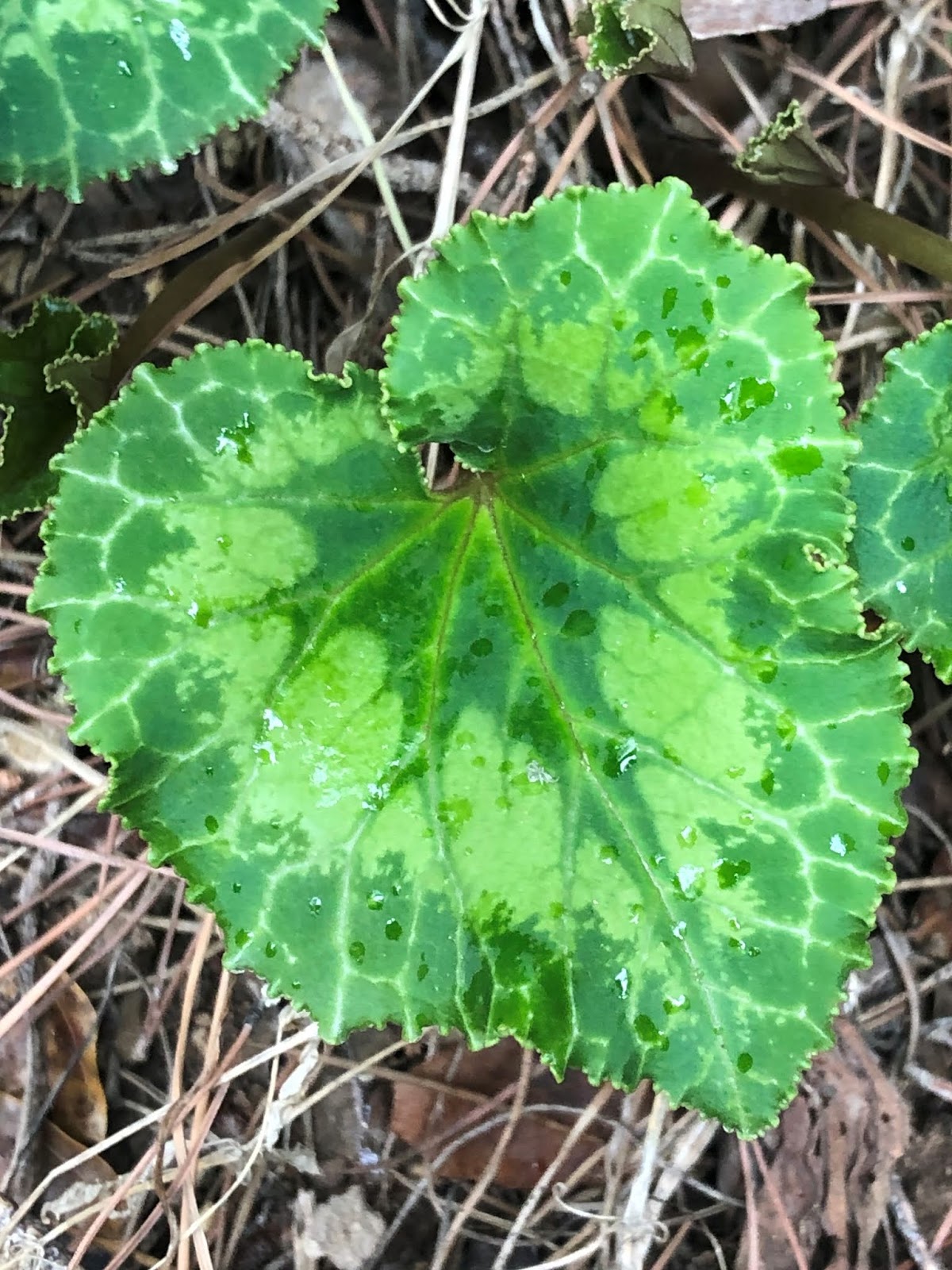
As I hinted at in my November blog the first rakefet leaves had just started appearing and thanks to the heavy rainfall there are more and more peeping out by the day.  The rakefet leaves are the most beautiful leaves in nature because of their intricate patterns.  This pattern provides them with their own identikit.  Why do prisoners have their fingerprints taken?  Because each person has a unique fingerprint that they can be identified by.  Every cyclamen plant has its own individual ‘fingerprint’. Many plants can be growing alongside each other and all the leaves coming out of one bulb will look totally different from the set of leaves coming out of the bulb next to it.  A good mindfulness exercise is to sit down next to a crop of plants and compare the patterns in the leaves.

In the past the young leaves were used like grape vine leaves and would be stuffed with meat and rice however it now has protected flower status and therefore picking them is forbidden.

Thank goodness the rain has started to fall seriously which is about time.  At the same time the rakefet is starting to flower producing a brown reddish stalk supporting a flower with petals that are a strong pink at the bottom and then they change to different hues of white to pink and every shade in between.  This flower needs to be very clever in order to survive the strong winter rains.  In theory these windy stormy days would easily wash away the delicate pollen in the center of the flower.  In order to outwit the rain our little rakefet flower therefore grows upside down.  If you look into the middle of the petals you will be surprised to notice that there is no pollen there.  In order to see the pollen you have to delicately turn the flower upside down or lie on the floor and look underneath the flower.  Most of my blogs will relate at some point to how the flower adapts to survive, spread its seed further, or beat the competition.  It is actually one of my greatest fascinations in nature and it has also helped further the whole scientific field of biomimicry – using tried and tested nature to find sustainable solutions to human problems.

In my June blog about the caper bush I told my first King Solomon fable.  He was known to be a great nature lover as described in the book of Kings He spoke about plant life, from the cedar of Lebanon to the hyssop that grows out of walls.” Kings 1, 4:33.
Here is my favorite story about King Solomon:
It was decided that King Solomon needed a new crown and because he loved the wild flowers so much he went for a walk to choose a flower that would inspire him.  He walked among so many beautiful flowers in an array of bright colours and they all lifted their heads up high so he would see them better and choose one of them.  None of them quite touched him and he carried on wandering getting quite despondent.  Finally he spotted one hidden among the rocks in a delicate shade of pink, hanging its head.  He whispered to it “you are a beautiful flower, so gentle and modest, I will be happy to design my crown to look like you so that whenever I wear it I will remember to be gentle and modest like you. 
This story will ring true with teachers who tend to choose the child who isn’t shouting out the answer or putting his hand up into the teachers face, instead choosing the one standing quietly and patiently.


The cyclamen season will last for a while now, sometimes starting as early as October and lasting until May.  It is a very common flower found in every part of the country and at Neot Kedumim we will have carpets of them in the following months. They tend to prefer some shade, growing well in the forests and as mentioned in the story they often grow under the shadow of rocks and sometimes even out of rocks as their bulbs wedge in the cracks.  For many years I have had a cyclamen growing out of the drainpipe in my garden but it hasn’t made an appearance this year and every day I eagerly search it out.(Update: it's definitely disappeared, probably washed out by heavy rains, and I hope it has gone to the cyclamen farm in the sky).


In my November blog I mentioned the crocus which wasn’t to be confused with the sitvanit hayore.  This is now blossoming everywhere and it is always out just in time for the festival of Hanukkah.  Inside our homes we light Chanukah candles while in nature this beautiful white flower with its deep yellowy orange center has earned itself the nickname of ‘the first Chanukah candle’.


Photos: Yasmin Maissel